Buy visionblog.eu ?
We are moving the project
visionblog.eu .
Are you interested in purchasing the domain
visionblog.eu ?
domain@kv-gmbh.de · 0541-91531010
Buy visionblog.eu ?
What did Giacomo Casanova do to get women?
Giacomo Casanova was known for his charm, wit, and intelligence, which he used to captivate and seduce women. He was a skilled conversationalist and had a talent for making women feel special and desired. Casanova also had a reputation for being a great listener and being attentive to a woman's needs and desires. Additionally, he was known for his confidence and boldness, which added to his allure and made him irresistible to many women. **
What are vineyard snails?
Vineyard snails, also known as grape snails, are a species of snail commonly found in vineyards and other agricultural areas. They are known for their voracious appetite for grape leaves and can cause significant damage to grapevines if left unchecked. Vineyard snails are a particular concern for grape growers, as they can impact the health and yield of grape crops. Measures such as manual removal, natural predators, and chemical control are often used to manage vineyard snail populations. **


Similar search terms for Baraldo-Giacomo-Sangiovese-Vineyard
Top-Angebote
Products related to Baraldo-Giacomo-Sangiovese-Vineyard:
-
Fenocchio Giacomo Nebbiolo Giacomo Fenocchio 2024The Langhe Nebbiolo from the family-run winery Giacomo Fenocchio represents a fresh and balanced interpretation of the noble grape variety Nebbiolo. The origins of the historic winery Giacomo Fenocchio date back to 1864, and since then, different generations of the Fenocchio family have passed down their knowledge of the craft and the territory. Today, at the helm of the estate is Claudio Fenocchio, a true winemaker who personally oversees every aspect of production, from the vineyard to vinification, strictly in line with tradition. Giacomo Fenocchio Langhe Nebbiolo comes from only grapes of the same-named black variety grown sustainably at an altitude of about 300 meters above sea level. The vines, averaging 15 years of age, extend over a hilly area facing east and characterized by soils dating back to the Elveziano, composed of clay sediments, blue marls, and tuff. The harvest takes place in mid-October, and the grapes are then pressed in stainless steel tanks where alcoholic fermentation occurs spontaneously in contact with the skins for about 10 days. The subsequent maturation phase takes place for 6 months always in steel and for another 6 months in large Slavonian oak barrels. This is followed by bottling and an additional resting in glass before the final market release. The Langhe Nebbiolo by Giacomo Fenocchio has a bright ruby red color with subtle garnet reflections. Intense and inviting aromatic profile with notes of plum, cherry, and rose petals that blend with pleasant hints of licorice. On the palate, it is full and balanced, with a good body and harmony, featuring a pleasant tannic structure that anticipates the finish consistent with the sensations perceived on the nose.19,00 £*Shipping: 48,00 £Secure redirect to the provider
-
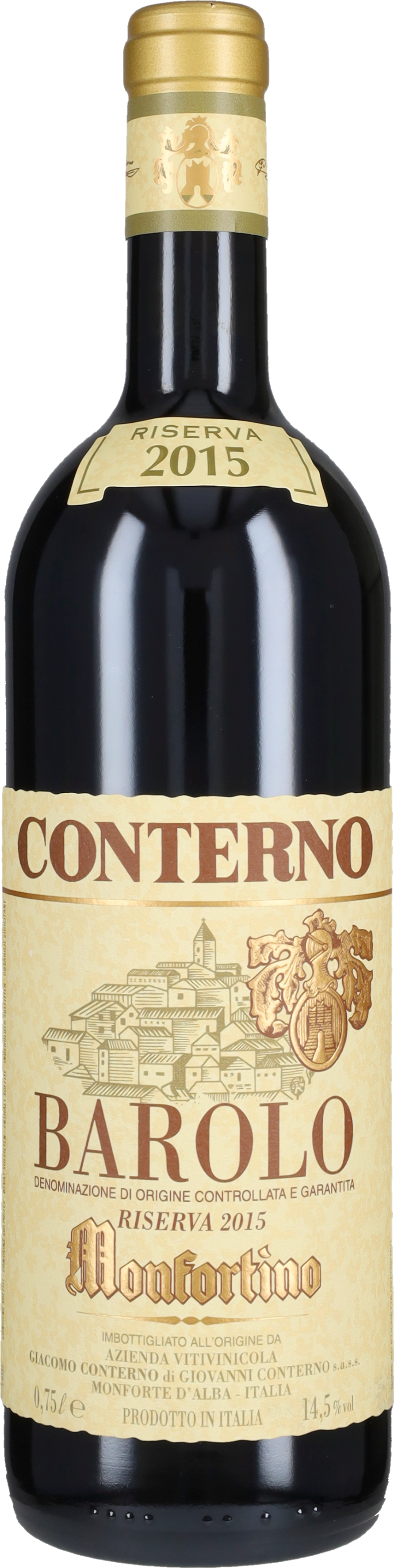
Conterno Giacomo Monfortino Riserva Giacomo Conterno 2015Monfortino is unabashedly a true liquid legend, an absolute outlier capable of rewriting the history of Barolo and sitting at the table of the world's greatest wines. A granite monument, it is an almost immortal creature given its ability to defy time and establish a dialectical relationship in which it even emerges enriched after decades. A piece of Langa, deep and territorial, as is the winery founded by the Conterno family in 1900 without ever failing, from that day forward, the classic and austere interpretation of a vocated vine such as Nebbiolo. The first Monfortino label appeared in 1924 to emphasize the location of the vineyards located in Monforte d'Alba, while since 1974, the wine has been made entirely from the Vigna Francia of Serralunga D'Alba. Monfortino Riserva comes from a selection of the best Nebbiolo grapes located in the Francia vineyard, the same vineyard from which Barolo and Barbera Cascina Francia, other historic Conterno wines, are derived. After meticulous sorting of the clusters, the first fermentation takes place in 61-hectoliter oak vats, with long macerations, including submerged cap macerations, as per tradition. Then the liquid is moved to large wooden barrels, mainly of Austrian origin, where after malolactic fermentation, it refines for about six years before bottling. Barolo Monfortino Riserva presents itself in the glass with a bright, iridescent garnet red colour. The nose is a poignant portrait of Langa, which is gradually and whisperingly revealed. Dog rose, violet, cherry: there is everything in this hymn to classicism, although to speak of descriptors is almost reductive given the harmony and cohesion of the aromas. The taste is experiential, a veritable cyclone that conquers the palate filling it with grace and power at the same time. The displacement of the liquid allows it to go very far while fading into an eternal persistence. A must-drink at least once in a lifetime.1234,00 £*Shipping: 48,00 £Secure redirect to the provider
-
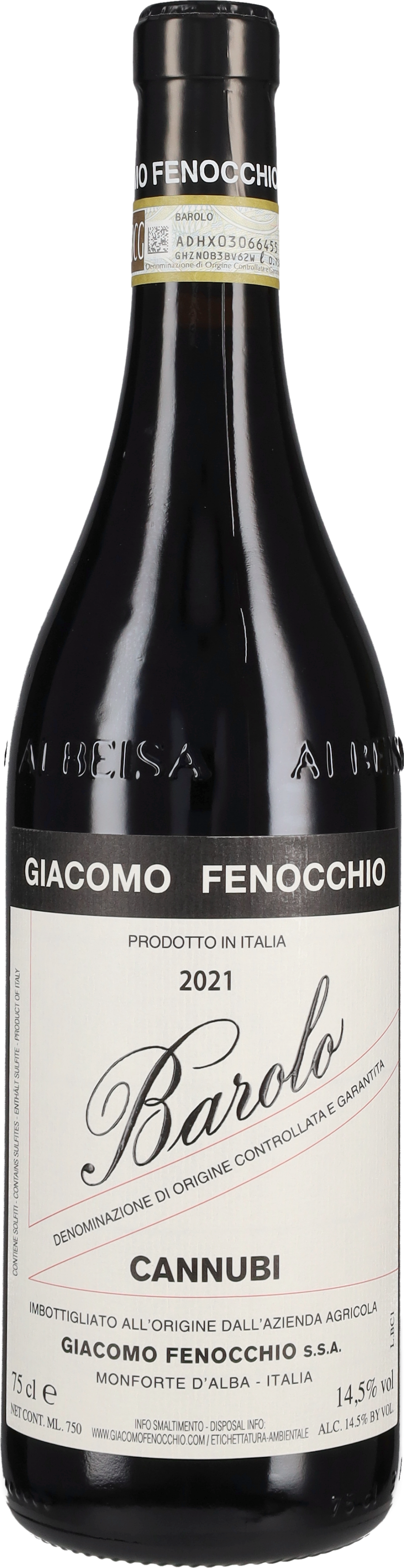
Fenocchio Giacomo Barolo 'Cannubi' Giacomo Fenocchio 2022The Barolo “Cannubi” by Giacomo Fenocchio is one of those wines before which one can only tip their hat in reverence. It already contains in its name the secret of this special character: the Cannubi, a world-famous Cru of Barolo, which has established itself in the history of the Langa – and beyond – for its qualities of superiority and excellence. The production style of the Giacomo Fenocchio winery, today guided by the eye and skilled hands of Claudio Fenocchio, is based on enhancing and respecting traditions. Only large barrels are used for the aging of its Barolo, thus allowing total expression of the grape variety and the terroir. The “Cannubi” by Giacomo Fenocchio is made from the Nebbiolo Michet variety. There are 0.5 hectares of the famous Cru designated for the production of this Barolo, located at an altitude of 280 meters above sea level. The vines have an average age of about 30 years and are exposed to the southeast, planted in a Tortonian soil composed of marls and tuff. The harvest is carried out manually in October.The maceration and alcoholic fermentation have a long duration, reaching up to 40 days. This is followed by a 6-month aging phase in steel tanks and a subsequent maturation of 30 months in large wooden barrels. Before being placed on the market, it rests for some time in the bottle. Giacomo Fenocchio Barolo “Cannubi” has a garnet red color with good transparency. The velvety texture is perceived on the nose as well as on the palate. In the aroma, it shows notes of cherry, raspberry, and a spicy background. It caresses the palate with a silky and noble tannin, set in a full-bodied and robust structure. Freshness and fruit come together in a crispness that invites drinking and determines the long life of this Barolo worthy of kings.74,00 £*Shipping: 48,00 £Secure redirect to the provider
-
Fenocchio Giacomo Barolo 'Castellero' Giacomo Fenocchio 2022The Barolo “Castellero” by Giacomo Fenocchio is a exemplar of elegance and tradition. At the core of Giacomo Fenocchio's winery philosophy is a strong passion for the vineyard and a great respect for the traditions that have shaped the Langa and its people over the centuries. Claudio Fenocchio is the current owner, coming from a long history that began in 1864; drawing on this cultural and experiential background, he can now create wines with complexity and expression. A convinced traditionalist and supporter of using large wood for aging, he aims to let that magical combination between the vineyard and the terroir express itself. “Castellero” by Giacomo Fenocchio is a so-called ‘Barolo di Barolo’, as it comes from vines located in the vicinity of the municipality that gives its name to the denomination. The vineyard used has an area of 0.8 hectares and consists of a Tortonian marly and tuff soil, with a good amount of sand. Nestled in a charming hilly landscape, the vines are oriented according to a west exposure, at an altitude of about 280 meters above sea level; their average age is around 30 years. The harvest is carried out manually during the first half of October. The maceration and fermentation phase, as per traditional style, lasts very long, reaching up to 40 days. A first stop of 6 months in steel tanks prepares the wine to undergo aging of 30 months in large wooden barrels. It concludes its journey with a bottle aging. Giacomo Fenocchio Barolo “Castellero” presents in the glass a garnet red color of great transparency. Its aroma unfolds with fruity and floral notes, earthy and spicy, closing with a hint of licorice. On the palate, it is fresh, savory, endowed with a smooth tannin and supported by a solid body. It plays its main traits on finesse and elegance. A red of noble spirit and strong character.60,00 £*Shipping: 48,00 £Secure redirect to the provider


-
Do vineyard snails eat paper?
No, vineyard snails do not eat paper. They are herbivores that primarily feed on plants, fruits, and vegetables. Paper is not a natural part of their diet, so they are unlikely to consume it. If you are experiencing issues with snails eating paper, it is more likely to be a different species of snail or pest. **
-
What is a vineyard snail?
A vineyard snail, also known as the Burgundy snail or Roman snail, is a species of land snail that is commonly found in vineyards and other agricultural areas. It is known for its distinctive spiral shell and is often considered a pest by grape growers, as it can damage grapevines and consume grape leaves. However, in some regions, vineyard snails are also harvested and used as a culinary delicacy, particularly in French cuisine. **
-
Are slugs homeless vineyard snails?
No, slugs are not homeless vineyard snails. While both slugs and vineyard snails can be found in vineyards, they are two different species. Slugs are gastropods that lack a shell, while vineyard snails are a type of land snail with a coiled shell. Both may be found in vineyards, but they are distinct creatures with different characteristics and behaviors. **
-
Is my vineyard snail dead?
It is difficult to determine if your vineyard snail is dead without more information. Look for signs of life such as movement, response to touch, and the condition of its body. If the snail is not moving and its body appears dried out or damaged, it may be dead. However, if you are unsure, it is best to consult with a veterinarian or an expert in snail care for a more accurate assessment. **
How can one sell vineyard snails?
One can sell vineyard snails by first ensuring they have the necessary permits and licenses to sell food products. Next, they can reach out to local restaurants, gourmet food stores, or farmers' markets to see if there is interest in purchasing the snails. Additionally, they can create an online presence through a website or social media to attract customers who are looking to buy vineyard snails. Lastly, offering samples or hosting tasting events can help showcase the quality and taste of the snails to potential buyers. **
How do I breed vineyard snails?
To breed vineyard snails, you will need to create a suitable environment for them. This includes providing a space with plenty of vegetation and a humid climate. You can also introduce a mating pair of snails to start the breeding process. Ensure that the snails have access to a calcium source for shell development and monitor their environment to ensure it remains suitable for breeding. With the right conditions, vineyard snails can reproduce and increase their population. **
Top-Angebote
Products related to Baraldo-Giacomo-Sangiovese-Vineyard:
-
Brezza Giacomo Nebbiolo Giacomo Brezza 2024A truly original and compelling Nebbiolo, aged only in stainless steel, with great drinkability and freshness. A wine that brings out the beautiful typical of the grape, without any aging in wood and, for this reason, lighter and more drinkable than many Nebbiolo of the area. A great table wine, perfect to pair with pasta dishes of the Italian tradition. The cellar Brezza is an absolute guarantee of quality and produces some of the most popular and award-winning Barolo. It is a traditional reality and, at the same time, dynamic, capable of giving an extraordinary quality without sacrificing innovation. To confirm this, simply open the elegant glass stopper that Brezza has chosen for this Nebbiolo won an experiment in place for a really delicious wine.17,00 £*Shipping: 48,00 £Secure redirect to the provider
-
Fenocchio Giacomo Nebbiolo Giacomo Fenocchio 2024The Langhe Nebbiolo from the family-run winery Giacomo Fenocchio represents a fresh and balanced interpretation of the noble grape variety Nebbiolo. The origins of the historic winery Giacomo Fenocchio date back to 1864, and since then, different generations of the Fenocchio family have passed down their knowledge of the craft and the territory. Today, at the helm of the estate is Claudio Fenocchio, a true winemaker who personally oversees every aspect of production, from the vineyard to vinification, strictly in line with tradition. Giacomo Fenocchio Langhe Nebbiolo comes from only grapes of the same-named black variety grown sustainably at an altitude of about 300 meters above sea level. The vines, averaging 15 years of age, extend over a hilly area facing east and characterized by soils dating back to the Elveziano, composed of clay sediments, blue marls, and tuff. The harvest takes place in mid-October, and the grapes are then pressed in stainless steel tanks where alcoholic fermentation occurs spontaneously in contact with the skins for about 10 days. The subsequent maturation phase takes place for 6 months always in steel and for another 6 months in large Slavonian oak barrels. This is followed by bottling and an additional resting in glass before the final market release. The Langhe Nebbiolo by Giacomo Fenocchio has a bright ruby red color with subtle garnet reflections. Intense and inviting aromatic profile with notes of plum, cherry, and rose petals that blend with pleasant hints of licorice. On the palate, it is full and balanced, with a good body and harmony, featuring a pleasant tannic structure that anticipates the finish consistent with the sensations perceived on the nose.19,00 £*Shipping: 48,00 £Secure redirect to the provider
-
Conterno Giacomo Monfortino Riserva Giacomo Conterno 2015Monfortino is unabashedly a true liquid legend, an absolute outlier capable of rewriting the history of Barolo and sitting at the table of the world's greatest wines. A granite monument, it is an almost immortal creature given its ability to defy time and establish a dialectical relationship in which it even emerges enriched after decades. A piece of Langa, deep and territorial, as is the winery founded by the Conterno family in 1900 without ever failing, from that day forward, the classic and austere interpretation of a vocated vine such as Nebbiolo. The first Monfortino label appeared in 1924 to emphasize the location of the vineyards located in Monforte d'Alba, while since 1974, the wine has been made entirely from the Vigna Francia of Serralunga D'Alba. Monfortino Riserva comes from a selection of the best Nebbiolo grapes located in the Francia vineyard, the same vineyard from which Barolo and Barbera Cascina Francia, other historic Conterno wines, are derived. After meticulous sorting of the clusters, the first fermentation takes place in 61-hectoliter oak vats, with long macerations, including submerged cap macerations, as per tradition. Then the liquid is moved to large wooden barrels, mainly of Austrian origin, where after malolactic fermentation, it refines for about six years before bottling. Barolo Monfortino Riserva presents itself in the glass with a bright, iridescent garnet red colour. The nose is a poignant portrait of Langa, which is gradually and whisperingly revealed. Dog rose, violet, cherry: there is everything in this hymn to classicism, although to speak of descriptors is almost reductive given the harmony and cohesion of the aromas. The taste is experiential, a veritable cyclone that conquers the palate filling it with grace and power at the same time. The displacement of the liquid allows it to go very far while fading into an eternal persistence. A must-drink at least once in a lifetime.1234,00 £*Shipping: 48,00 £Secure redirect to the provider
-
What did Giacomo Casanova do to get women?
Giacomo Casanova was known for his charm, wit, and intelligence, which he used to captivate and seduce women. He was a skilled conversationalist and had a talent for making women feel special and desired. Casanova also had a reputation for being a great listener and being attentive to a woman's needs and desires. Additionally, he was known for his confidence and boldness, which added to his allure and made him irresistible to many women. **
-
What are vineyard snails?
Vineyard snails, also known as grape snails, are a species of snail commonly found in vineyards and other agricultural areas. They are known for their voracious appetite for grape leaves and can cause significant damage to grapevines if left unchecked. Vineyard snails are a particular concern for grape growers, as they can impact the health and yield of grape crops. Measures such as manual removal, natural predators, and chemical control are often used to manage vineyard snail populations. **
-
Do vineyard snails eat paper?
No, vineyard snails do not eat paper. They are herbivores that primarily feed on plants, fruits, and vegetables. Paper is not a natural part of their diet, so they are unlikely to consume it. If you are experiencing issues with snails eating paper, it is more likely to be a different species of snail or pest. **
-
What is a vineyard snail?
A vineyard snail, also known as the Burgundy snail or Roman snail, is a species of land snail that is commonly found in vineyards and other agricultural areas. It is known for its distinctive spiral shell and is often considered a pest by grape growers, as it can damage grapevines and consume grape leaves. However, in some regions, vineyard snails are also harvested and used as a culinary delicacy, particularly in French cuisine. **
Similar search terms for Baraldo-Giacomo-Sangiovese-Vineyard
-
Fenocchio Giacomo Barolo 'Cannubi' Giacomo Fenocchio 2022The Barolo “Cannubi” by Giacomo Fenocchio is one of those wines before which one can only tip their hat in reverence. It already contains in its name the secret of this special character: the Cannubi, a world-famous Cru of Barolo, which has established itself in the history of the Langa – and beyond – for its qualities of superiority and excellence. The production style of the Giacomo Fenocchio winery, today guided by the eye and skilled hands of Claudio Fenocchio, is based on enhancing and respecting traditions. Only large barrels are used for the aging of its Barolo, thus allowing total expression of the grape variety and the terroir. The “Cannubi” by Giacomo Fenocchio is made from the Nebbiolo Michet variety. There are 0.5 hectares of the famous Cru designated for the production of this Barolo, located at an altitude of 280 meters above sea level. The vines have an average age of about 30 years and are exposed to the southeast, planted in a Tortonian soil composed of marls and tuff. The harvest is carried out manually in October.The maceration and alcoholic fermentation have a long duration, reaching up to 40 days. This is followed by a 6-month aging phase in steel tanks and a subsequent maturation of 30 months in large wooden barrels. Before being placed on the market, it rests for some time in the bottle. Giacomo Fenocchio Barolo “Cannubi” has a garnet red color with good transparency. The velvety texture is perceived on the nose as well as on the palate. In the aroma, it shows notes of cherry, raspberry, and a spicy background. It caresses the palate with a silky and noble tannin, set in a full-bodied and robust structure. Freshness and fruit come together in a crispness that invites drinking and determines the long life of this Barolo worthy of kings.74,00 £*Shipping: 48,00 £Secure redirect to the provider
-
Fenocchio Giacomo Barolo 'Castellero' Giacomo Fenocchio 2022The Barolo “Castellero” by Giacomo Fenocchio is a exemplar of elegance and tradition. At the core of Giacomo Fenocchio's winery philosophy is a strong passion for the vineyard and a great respect for the traditions that have shaped the Langa and its people over the centuries. Claudio Fenocchio is the current owner, coming from a long history that began in 1864; drawing on this cultural and experiential background, he can now create wines with complexity and expression. A convinced traditionalist and supporter of using large wood for aging, he aims to let that magical combination between the vineyard and the terroir express itself. “Castellero” by Giacomo Fenocchio is a so-called ‘Barolo di Barolo’, as it comes from vines located in the vicinity of the municipality that gives its name to the denomination. The vineyard used has an area of 0.8 hectares and consists of a Tortonian marly and tuff soil, with a good amount of sand. Nestled in a charming hilly landscape, the vines are oriented according to a west exposure, at an altitude of about 280 meters above sea level; their average age is around 30 years. The harvest is carried out manually during the first half of October. The maceration and fermentation phase, as per traditional style, lasts very long, reaching up to 40 days. A first stop of 6 months in steel tanks prepares the wine to undergo aging of 30 months in large wooden barrels. It concludes its journey with a bottle aging. Giacomo Fenocchio Barolo “Castellero” presents in the glass a garnet red color of great transparency. Its aroma unfolds with fruity and floral notes, earthy and spicy, closing with a hint of licorice. On the palate, it is fresh, savory, endowed with a smooth tannin and supported by a solid body. It plays its main traits on finesse and elegance. A red of noble spirit and strong character.60,00 £*Shipping: 48,00 £Secure redirect to the provider
-
Are slugs homeless vineyard snails?
No, slugs are not homeless vineyard snails. While both slugs and vineyard snails can be found in vineyards, they are two different species. Slugs are gastropods that lack a shell, while vineyard snails are a type of land snail with a coiled shell. Both may be found in vineyards, but they are distinct creatures with different characteristics and behaviors. **
-
Is my vineyard snail dead?
It is difficult to determine if your vineyard snail is dead without more information. Look for signs of life such as movement, response to touch, and the condition of its body. If the snail is not moving and its body appears dried out or damaged, it may be dead. However, if you are unsure, it is best to consult with a veterinarian or an expert in snail care for a more accurate assessment. **
-
How can one sell vineyard snails?
One can sell vineyard snails by first ensuring they have the necessary permits and licenses to sell food products. Next, they can reach out to local restaurants, gourmet food stores, or farmers' markets to see if there is interest in purchasing the snails. Additionally, they can create an online presence through a website or social media to attract customers who are looking to buy vineyard snails. Lastly, offering samples or hosting tasting events can help showcase the quality and taste of the snails to potential buyers. **
-
How do I breed vineyard snails?
To breed vineyard snails, you will need to create a suitable environment for them. This includes providing a space with plenty of vegetation and a humid climate. You can also introduce a mating pair of snails to start the breeding process. Ensure that the snails have access to a calcium source for shell development and monitor their environment to ensure it remains suitable for breeding. With the right conditions, vineyard snails can reproduce and increase their population. **
* All prices are inclusive of VAT and, if applicable, plus shipping costs. The offer information is based on the details provided by the respective shop and is updated through automated processes. Real-time updates do not occur, so deviations can occur in individual cases. ** Note: Parts of this content were created by AI.